
Content note: This article discusses drug-facilitated sexual assault. If you need support, RAINN’s National Sexual Assault Hotline is available 24/7 at 800-656-HOPE (4673).
If you suspect you were drugged, knowing how long roofies stay in your system matters. A clear answer helps you plan your next move, whether that’s getting tested or understanding what’s happening in your body.
That understanding starts with knowing what Rohypnol is. Known on the street as roofies, Rohypnol is a powerful sedative prescribed in other countries for insomnia and for sedation before surgery. Over time, people began using it to spike drinks without the other person’s knowledge. Because it can dissolve without an obvious color, taste, or smell, many people have no idea they took it until the effects set in. This guide covers what the drug does, the Rohypnol detection window you’re likely asking about, and what a drug test for roofies can tell you.
What Is Rohypnol?
Rohypnol is the brand name for flunitrazepam, a sedative that calms the brain and body. It belongs to a drug class called benzodiazepines, medications that slow down the central nervous system. That’s the same class as Xanax and Valium, but Rohypnol is far stronger. A clinical review in American Family Physician puts its potency at roughly 10 times that of diazepam (Valium). On the street, you might hear it called rope, R2, circles, or the forget-me-pill, a nickname that reflects the memory loss it can cause.
Rohypnol is a Schedule IV controlled substance under the federal Controlled Substances Act, which the Drug Enforcement Administration (DEA) enforces. Unlike most Schedule IV drugs, though, it has never been approved for medical use in the United States. It can’t be legally manufactured, sold, or imported here, and penalties for possessing or distributing one gram or more match those for Schedule I drugs. Outside the U.S., it is legally manufactured and prescribed in many countries, most commonly for insomnia.
How Is Rohypnol Used and Why Is It Dangerous?
People take Rohypnol in a few different ways. Some swallow it whole, while others crush and snort it or dissolve it into a drink. That ability to dissolve is exactly what makes it dangerous in social settings, since a dose can slip into someone’s cup without their knowledge.
Because the early symptoms look a lot like ordinary drunkenness, people nearby often don’t recognize what’s happening until well after it starts. Since 1997, brand-name Rohypnol has been made with a blue core that dyes light-colored drinks blue. Generic versions may not contain the dye, though, so a visual check alone may not catch it.
Signs and Symptoms to Watch For
Rohypnol slows down your central nervous system, and effects typically begin within about 30 minutes. If you suspect you’ve been roofied, watch for several signs appearing together rather than just one, since a cluster of symptoms is what usually points to a drug instead of plain intoxication.
Some of the symptoms to look out for include:
- Nausea or vomiting
- Memory gaps or blackouts
- Slurred speech
- Trouble with balance and coordination
- Slower reaction times
- Heavy drowsiness
- Confusion or poor judgment
- Shallow, slowed breathing that can turn life-threatening
If you notice several of these at once, in yourself or a friend, seek emergency care right away instead of waiting to see if it passes. For a closer look at warning signs, see our guide to the signs you were drugged.
How Long Do Roofies Stay in Your System?
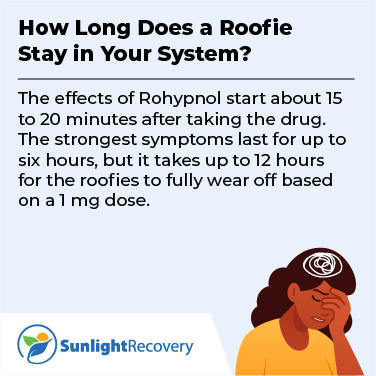
Once Rohypnol enters your system, the timeline moves fast, but it’s different for each person. According to a clinical review in American Family Physician, effects typically begin about 30 minutes after ingestion, peak around the two-hour mark, and may last 8 to 12 hours. Some people may still feel groggy or unsteady into the next day.
Taking Rohypnol with alcohol or another sedative can make the effects much stronger, since the substances amplify each other. Learn more about the risks of mixing benzodiazepines and alcohol. Exact timing varies by dose and individual tolerance. Body weight and how fast your body metabolizes, or breaks down, drugs also play a role, so the ranges above are typical rather than exact for any one person.
Because amnesia is one of Rohypnol’s effects, people may have little or no memory of what happened while the drug was active. That’s part of why so many survivors struggle to identify who gave them the drug.
What to Do If You Think You Were Drugged
If you or a friend may have been drugged, your safety comes first. You don’t need proof to act on the suspicion.
- Call 911 right away if someone is unconscious, can’t be woken, or is having trouble breathing.
- Get to a safe place with a friend you trust, away from anyone who may have drugged you.
- Go to an emergency room and tell the staff you think you were drugged. Ask for toxicology testing, and for a forensic exam if you may have been sexually assaulted.
- If you need to urinate before you can get to care, RAINN recommends saving the urine in a clean, sealable container and refrigerating or freezing it.
If you were sexually assaulted, you are not to blame. RAINN’s National Sexual Assault Hotline offers free, confidential support 24/7. Call 800-656-HOPE (4673), chat at RAINN.org/hotline, or text “HOPE” to 64673. Support specialists can help you find a hospital or provider that offers forensic exams and toxicology testing.
Getting Tested: Detection Windows by Method
A Rohypnol detection window depends on the test used and how soon after exposure it’s taken. Standard drug panels rarely screen for Rohypnol, so a lab has to run a specific test built to catch it. That makes telling the clinic exactly what you suspect more important than it would be with most other substances.
Urine Testing
A urine sample is the most common drug test for roofies, and the one most clinics reach for first. Metabolites are the breakdown products your body makes as it processes a drug. Standard lab testing can detect Rohypnol and its main metabolite for up to 72 hours after ingestion. In a controlled study using a highly sensitive forensic method, the metabolite was detected up to 14 days after a single dose in some participants. Results grow less reliable the longer you wait, so getting to a clinic within the first two to three days improves the odds of detection.
Hair Testing
Once those first three days pass, a hair test becomes the next option. Hair holds onto drug traces far longer than urine, and research has detected Rohypnol’s metabolite in hair up to 28 days after a single dose. That makes it useful for anyone who realized what happened well after the fact.
Blood Testing
Blood tests can catch Rohypnol too, but within a much shorter window than urine. Labs use this method less often, since it works best when a sample is taken soon after exposure.
At-Home Test Kits
Several companies now sell home testing kits that let you collect a sample and mail it to a lab for review. These kits offer privacy if you’d rather not go to a clinic right away, though a test run by a medical professional still tends to catch more and carries fewer chances of a mishandled sample.
Staying Safe at Bars, Clubs, and Parties
A few habits go a long way toward lowering your risk in the first place. Since Rohypnol can be hard to see, taste, or smell in a drink, your best defense comes down to controlling your drink from the moment it’s poured until the moment it’s empty.
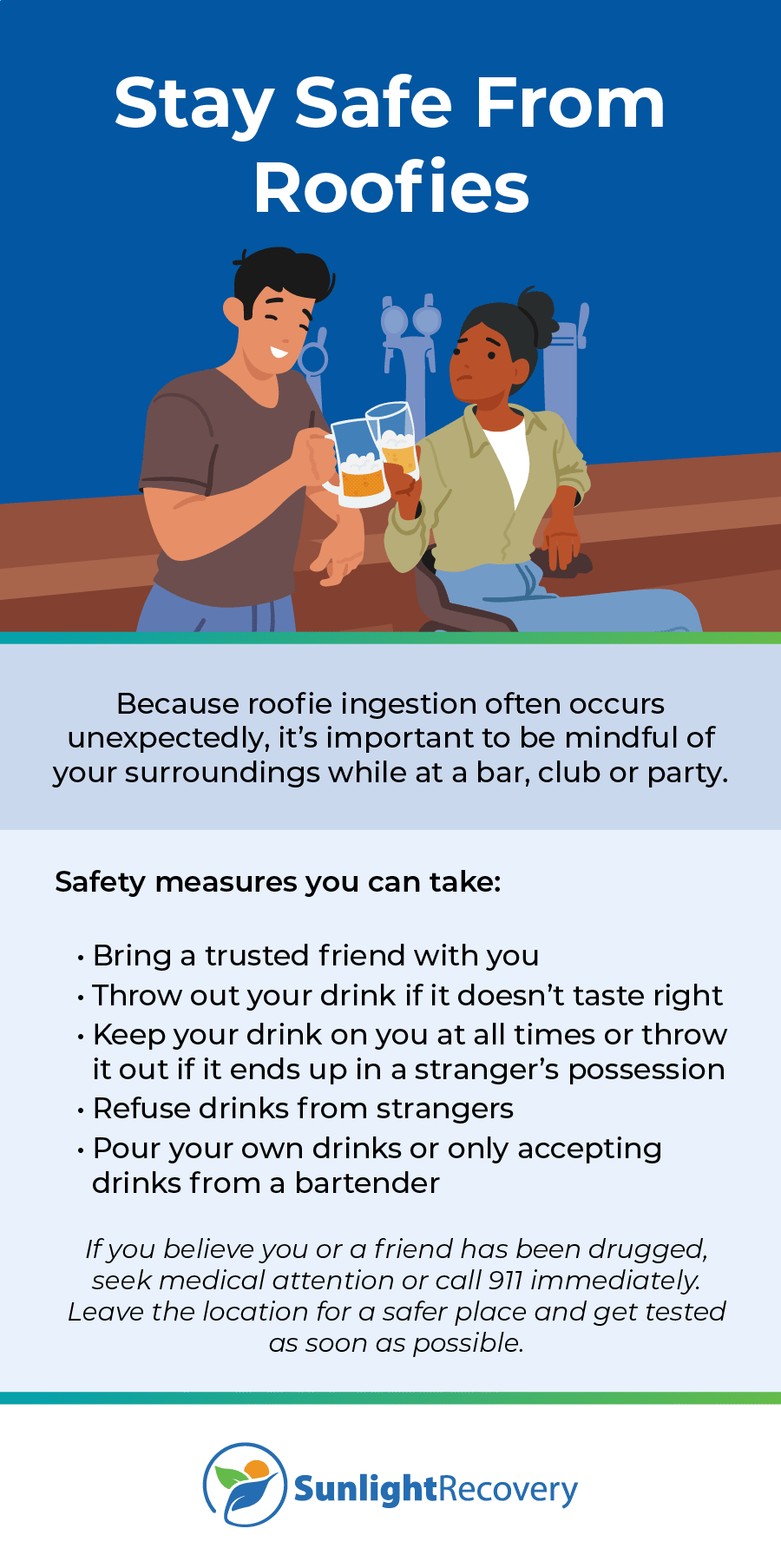
- Bring a friend you trust and watch out for each other
- Watch your drink get made and keep it in sight the whole time
- Pour out a drink that tastes strange, looks cloudy, or sat unattended even briefly
- Turn down drinks offered by people you just met
- Order drinks straight from the bartender rather than accepting one already poured
If you ever suspect a drink has been tampered with, treat that instinct as reason enough to act, even without proof.
When Does Roofie Use Turn Into Dependence?
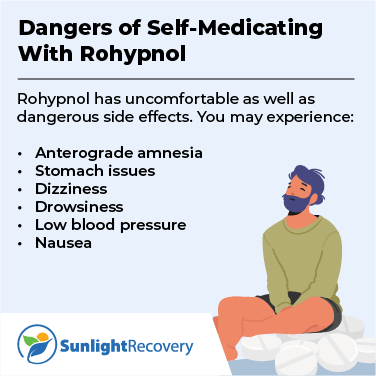
Some people take Rohypnol on their own to self-medicate insomnia or anxiety. Because it isn’t legally available in the U.S., people who use it here obtain it illicitly, and that path carries its own risks separate from drink spiking. Regular use can bring on stomach trouble, dizziness, heavy drowsiness, and low blood pressure. It can also cause anterograde amnesia, trouble forming new memories after taking the drug. That’s the same effect seen in spiking cases, where entire stretches of time disappear.
Your body can also build tolerance to benzodiazepines, so the dose that once worked stops being enough. Taking more raises the risk of overdose, especially alongside alcohol or opioids. Stopping suddenly after regular use can bring on withdrawal symptoms such as anxiety, restlessness, headaches, and muscle pain, along with an increased risk of seizures. That’s why people who have been using this drug regularly are encouraged to seek medically supervised detox rather than quitting on their own.
How Sunlight Recovery Can Help
If Rohypnol has become part of your daily life, no matter how it started, you deserve support instead of facing this on your own. At Sunlight Recovery, our clinical team provides benzodiazepine addiction treatment, including medical detox and residential care at our Boca Raton campus. Each plan is built around your history, your health, and what recovery looks like for you.
Call our 24/7 admissions line at (855) 625-6684. Every call is confidential, with no obligation. You can also reach out online for a private conversation about your options.